

Looking to visit the Hopewell Rocks?
If you are, you have certainly come to the right place. I was on a road trip to Atlantic Canada, and the Hopewell Rocks are one of the top attractions in New Brunswick, so I just had to stop by and check them out.
So are the Hopewell Rocks Worth Visiting? Yes and yes, as this place is amazing. And I wasn’t alone as it was very busy during my visit, including plenty of couples and families; a few even brought their dogs.
Use my helpful guide for the best experience visiting the Hope Rocks Provincial Park.
Short on time?
Avoid the lineups by purchasing your Hopewell Rocks admission ticket in advance.


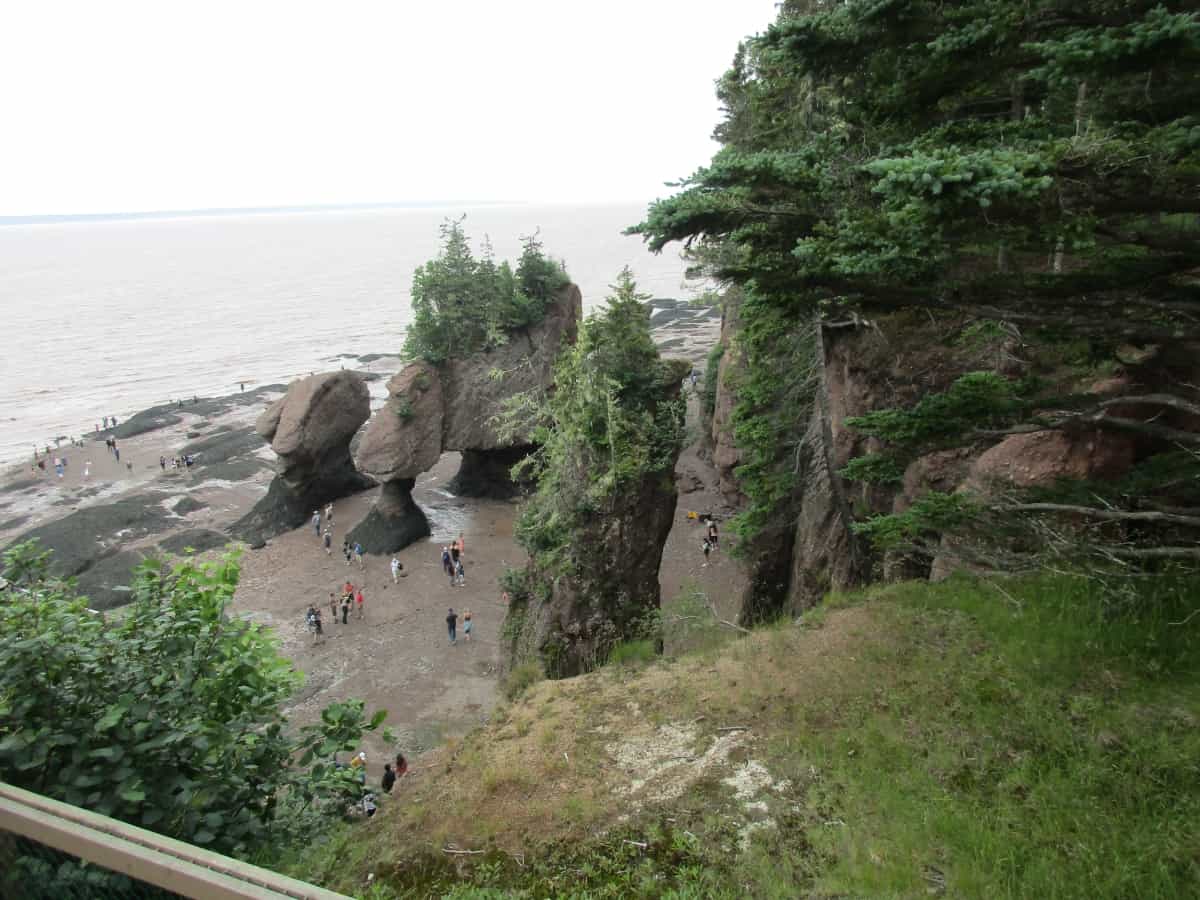
Located on the Fundy Coast of New Brunswick, I got to walk on the ocean floor at low tide and see rock formations known as the Hopewell Rocks (also known as Flowerpots Rocks), which are sea stacks rising from the ocean floor.

Interpretive Centre
From the huge main parking lot, you head to the main entrance with the Interpretive Centre just a short walk away. Inside the Visitor Centre is a good introduction to the area with a self-guided multimedia exhibit explaining how the formations were created. I learned about the tides (the Bay of Fundy has the highest tides in the world), heard sounds of whales found in the Bay of Fundy, and saw a life-sized model of an Atlantic Right Whale. There is also information about the local Mi’kmaq.
In the main building, Parks staff were available to answer my questions. The High Tide Restaurant has casual offerings, including local beer, with its dining deck overlooking a tidal flat. There is also a gift shop at the Interpretive Centre.
Hopewell Rocks Trails
1. Ocean Floor Access Trail

Length of Trail: Starting from the Interpretive Center for an easy 2.4 km out and back
Highlights: Invigorating forest walk
Elevation: 35 meters
Note: You can walk the trail or use the shuttle service for a fee
The reason everyone wants to visit Hopewell Rocks Provincial Park is to see the rock formations, so the best way is to start right away with this trail. The fastest way to get to the ocean floor walk area is to use the shuttle service for a fee of about $2.00. Or, like me, you can just walk the easy and wide trail through the woods, which takes about 25 minutes.
At Staircase Cove, you will arrive at a small plaza where the shuttle also stops. Then it is 101 steps round and round as you descend to the ocean floor, although you get great views along the way. If you want to avoid the stairs, continue to nearby North Beach, where there is a ramp with benches for a gentle descent. Note that the ramp is suitable for wheelchairs, but the ocean floor can be tough to move the wheels.
2. Ocean Floor Walk
Length of Trail: Easy
Highlights: ocean floor walk at low tide, sea stacks
Caution: the tides can come in quickly
After leaving the staircase (or North Beach ramp), just follow the route along the 2 kilometers of ocean floor, viewing the coves, sea caves, sea stacks, and at one point going under an arch until reaching the far end by the emergency tower. There are several New Brunswick Parks staff along the way to answer questions and ensure safety.
You will see different sizes and shapes of the sea stacks (also known as flowerpots). The Parks people have been very creative with naming the rocks, such as ET, Dinosaur, Bear, Elephant, Mother-in-Law, Diamond, and Apple. There was a line-up of people at Lover’s Arch, so I had to wait my turn for a photo.
Walking on the exposed ocean floor was easy, but there were muddy parts to avoid, and I was wearing sturdy and comfortable shoes. Just as I reached the far end of the route, the Parks staff advised that the tide was starting to come in, with the water level rising, so they slowly began moving people back towards the staircase.
3. Big Cove Lookout Trail

Length of Trail: easy 1.6 km out and back as a side trail from the Ocean Floor Access Trail
Highlights: views from Big Cove Lookout, peregrine falcon
A short side trail through the woods is well worth the effort to walk to the Big Cove Lookout Point viewing platform. During my visit, I was able to see a peregrine Falcon.
4. Daniels Flats Lookout Trail
Length of trail: easy short walk from the Welcome Centre
Highlights: views
Heading from the Interpretive Centre, another of the walking trails takes you to two lookout points of the Daniels mudflats.
5. Demoiselle Beach Trail
Length of trail: Easy 1.6 km out and back
Highlights:
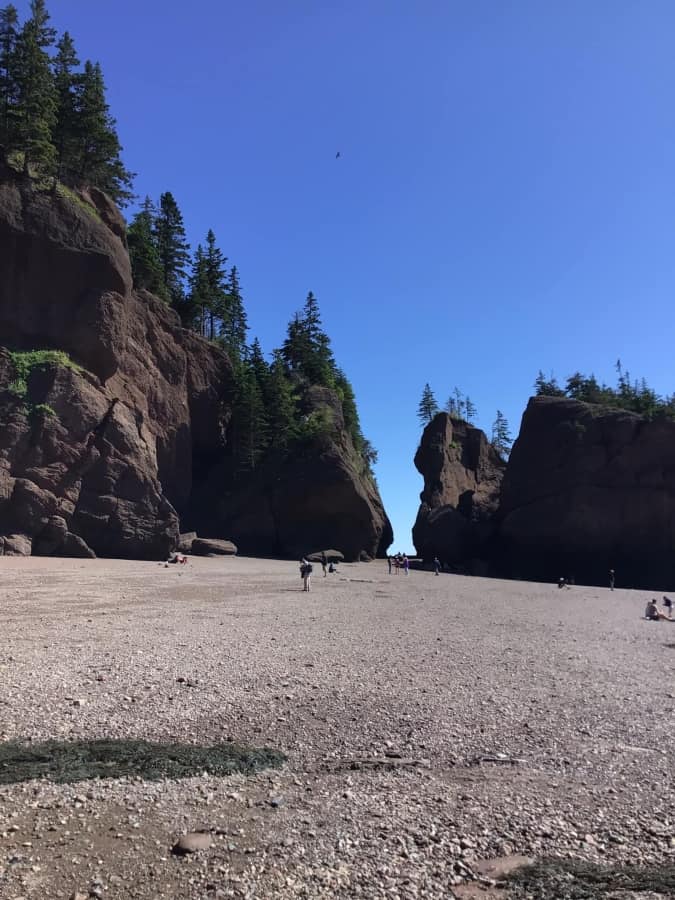
Finally, the treasures of Demoiselle await those who take a short hike through the wooded trail leading south from behind the Interpretive Centre. This is the third of the ocean-floor access points with no stairs or ramps as the trail gently descends to sea level. Once there, you will find the scenery is amazing with the high cliffs and the ocean views.
Other Activities at Hopewell Rocks Provincial Park

You cannot bring your own equipment, but kayak tours, canoeing, and paddleboarding are available from Baymount Outdoor Adventures to explore the Rocks at high tide.
Hopewell Rocks Tides

The First thing I did before my visit was to check the Hopewell Rocks tide tables before going. I got there at low tide. Lucky. You’ll want to visit the Hopewell Rocks during both high tide and low tide so you can truly appreciate the height and range of the Bay of Fundy tides, due to the extreme range. Six hours separate high and low tide.
Depending on your situation and the tide schedule, you may wish to stay at the park for six hours to see both the low and high tides. As the tickets are always sold for two consecutive days, you may wish to return if staying nearby.
Hopewell Rocks Provincial Park Reservations
Advance reservations are not required, but you may wish to purchase your entrance fee in advance to avoid any lineups at the main entrance. I was glad I did that as it was quite busy when I arrived.
Your tickets are good for 2 consecutive days, which lets you see them at both low and high tide. The park is open from mid-May until the end of October, but hours of operation do vary. For safety reasons, you cannot visit the rocks when the park is not open.
Pets are permitted but must be on a leash at all times (leashes may not exceed 3 meters or 10 feet). Pets are not permitted in the buildings unless they are service animals.
About the Hopewell Rocks

With over twenty free-standing sea stacks with interesting names scattered along two kilometers of shoreline, a natural wonder, no East Coast vacation is complete without a visit. The province of New Brunswick in the late 1990s decided to make this its flagship park as part of a plan to market the Bay of Funday area.
The Bay of Fundy tides have the world’s highest tides at 14 meters (or 46 feet) between low and high tide, with erosion caused by this shaping these flowerpot rocks. Also known as the Hopewell Rocks, the formations are made of conglomerate cemented together by gypsum and limestone and were formed in river deltas from raging torrents flowing down from the ancient Caledonian Mountains millions of years ago.
Wildlife in the Hopewell Rocks Park
There are year-round animals such as red squirrels, raccoons, groundhogs, porcupines, skunks, and snowshoe hares that live in the park. Larger animals, including white-tailed deer, moose, black bear, bobcat, lynx, and coyote, can sometimes be spotted as they pass through Hopewell Rocks Park.
The beach at the Rocks is also being used by migrating Semipalmated Sandpipers, sometimes as many as 50,000 arriving in late July or early August.
I was accompanied by chickadees as I walked the ocean floor access trail, although there are many other types of birds in the park. When taking the sidetrail, I observed one of the pair of nesting peregrine falcons residing since the spring of 2009.
How to Get to Hopewell Rocks Provincial Park
From Moncton to Hopewell Rocks, it is about 47 km on Highway 114 or a 36-minute drive. This is not a major road, and you first drive through the edge of Moncton and then the gently rolling countryside to the Hopewell Rocks Provincial Park entrance at 131 Discovery Road, Hopewell Cape.
Discover Cars has rental cars available if required for your visit.
If coming from Nova Scotia, Amherst, for example, is about 100 km away via the Trans Canada Highway.
A full-day Hopewell Rocks and Fundy National Park tour is available departing from Moncton.
Accommodation – Where to Stay
There is no Hopewell Rocks camping in the Provincial Park. However, Fundy National Park, just along the coast, has five campgrounds.
The Shepody Bay Inn at Hopewell Cape is about 8 km from the park, as is the Fundy Rocks Motel with more basic Facilities.
FAQs: Hopewell Rocks
Can you see the Hopewell Rocks for free?
No, the Hopewell Rocks are located in a New Brunswick Provincial Park, and an admission ticket is required. Your ticket is for 2 consecutive days, so you can see both the low and high tides.
How long should you spend at the Hopewell Rocks?
The tidal cycle is six hours, so you can visit Hope Rocks for that time to see both. Alternatively, as your ticket is for 2 consecutive days, you can go at low tide for about 2-3 hours and return for a shorter visit to see the high tide.
Where are the Hopewell Rocks located?
They are located in Hopewell Rocks Provincial Park on the Bay of Fundy coast about 47 km east of Moncton, New Brunswick.
What is the closest city to the Hopewell Rocks?
The closest city to the Hopewell Rocks is Moncton, New Brunswick, about 40 km away.
When can you walk on the ocean floor at the Hopewell Rocks?
One of the great things about the Hopewell Rocks is walking the ocean floor at low tide for about 2 km to see the arch, coves, and sea stacks.
What should I wear at the Hopewell Rocks?
You should wear sturdy walking shoes when visiting Hopewell Rocks. If visiting in the spring, also bring insect repellent.
Best time to visit Hopewell Rocks?
The best time to visit the Hopewell Rocks is during low tide, which varies day to day. The park is open from mid-May to the end of October and, for safety reasons, is closed in the evening.
Looking for more Information on Atlantic Canada?
- Also very popular is Newfoundland’s Gros Morne National Park
- A short drive from the Fundy Coast is Prince Edward Island National Park
- Things to do on Prince Edward Island – 25 ideas
- Greenwich Dunes Trail – if you liked the Hopewell Rocks, you will love this floating boardwalk on PEI
- Prince Edward Island Road Trip – 5 day itinerary for exploring the island
- Newfoundland Road Trip – to see the icebergs, puffins, whales and more
Final Thoughts: Things to Do at Hopewell Rocks
If you are on an Atlantic Canada road trip, this is a must-stop. At the Hopewell Rocks, you have the great experience of walking on the ocean floor while viewing coves, arches, and sea stacks.


